To Solve My Snoring Problem, I Built an iOS App - Snoreman
My roommate told me I snore at night—and sometimes I even wake her up. I also often wake up with a dry throat and feel like I didn’t sleep well.
After some research, I learned that snoring usually comes from a few common causes:
-
Obesity and neck fat accumulation: Extra tissue can narrow the airway. When your muscles relax during sleep, the airway can become even tighter. What can help:
- Sustainable weight loss: Even losing 5%–10% of body weight can reduce airway pressure.
- More exercise: Better muscle tone can help prevent tissues from collapsing too much at night.
-
Sleeping on your back: Gravity pulls the tongue and soft palate backward, partially blocking the airway—like closing a door halfway—making airflow noisy. What can help:
- Side sleeping: If you keep rolling onto your back, sewing a tennis ball onto the back of your pajamas is old-school but effective.
- Elevate your head: Raising your pillow by 10–15 cm can help keep the airway more open.
-
Nasal or throat issues: For example, allergic rhinitis can increase resistance and trigger mouth breathing. What can help:
- Targeted treatment: Nasal irrigation, or anti-allergy sprays under medical guidance.
- Quit smoking and limit alcohol: Alcohol relaxes airway muscles; smoking irritates and inflames the airway.
- Devices (for severe cases): Talk to a doctor about CPAP or an anti-snoring mouthguard.
For me, #2 and #3 are the likely culprits. I’m planning to try side sleeping, nasal irrigation, and some oral/throat muscle exercises to see if I can fix it.
The frustrating part is: while you’re asleep, you have no idea whether any of this is working. The only reliable way is to record overnight audio and review it the next day.
There are existing options—recording yourself and writing code to analyze it—but that’s too much hassle. I looked for ready-made apps:
- SnowLab can record and analyze snoring, but it costs about 75 CNY/month, which felt pricey for a single function.
- I tried a free app called “Little Sleep”, but it didn’t record anything that night. I couldn’t tell whether I truly didn’t snore or the app failed—and there was no saved audio to verify.
That pain point felt worth solving:
- Many sleep apps bundle too many features, and it takes forever to find the one thing you need.
- Apps focused on sleep audio monitoring often rely on subscriptions. But this is a purely local workflow. A one-time purchase (e.g., $1.99) feels much more reasonable—especially for people who were put off by a subscription that costs tens of yuan per month.
So I built my first iOS app:
Snoreman
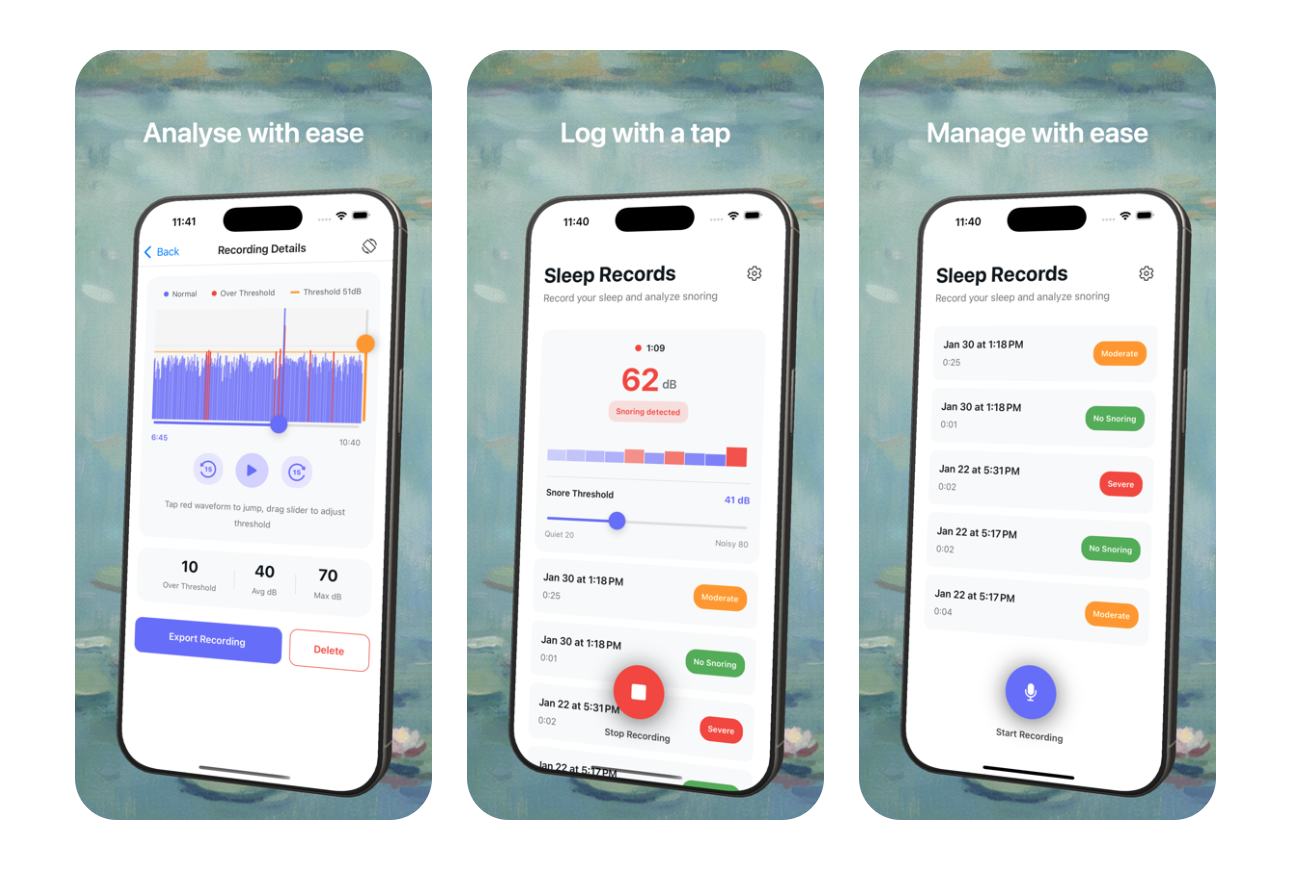
What it does:
- Simple: Open the app, tap one button, and start recording + analysis.
- Flexible review: Tap a recording, adjust the dB threshold, jump to suspected snoring segments, and listen immediately.
- Keeps your data: Original recordings are preserved and can be exported for analysis elsewhere.
- Efficient storage: An 8-hour recording only takes a few dozen MB.
- Resilient: If recording is interrupted, the audio captured so far is still saved properly.
If you want to confirm whether you’re snoring—or talking in your sleep—feel free to try Snoreman.